
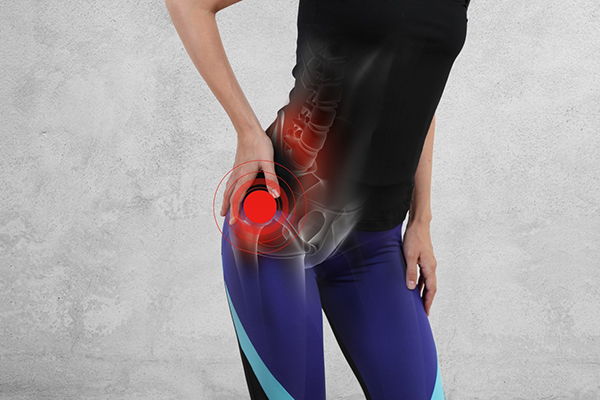
Hip pain has a way of rearranging your life. You skip the evening run, avoid low couches, and wince as you twist out of the car. When a deep ache in your groin or along the side of your hip keeps coming back, the cause often lies inside or around the joint itself. Here is how a hip arthroscopy surgeon finds that cause and what treatment may involve.
Why Hip Pain Deserves a Closer Look
Your hip is a ball and socket joint. The socket is ringed by a strong rim of fibrocartilage called the labrum, which works like a gasket to deepen and stabilize the joint, while smooth articular cartilage lets the bones glide.1 When the bones do not fit together perfectly or soft tissue is injured, squatting, pivoting, and climbing stairs can hurt.
Where you feel the pain offers an important clue. Pain inside the joint or in your groin usually points to a problem within the hip, while pain on the outer hip, upper thigh, or buttock often comes from the muscles, tendons, and soft tissues around it. That is why our evaluation of hip pain starts with a careful look at your symptoms and how they change with movement.
Hip Conditions Arthroscopy May Treat
Hip arthroscopy uses a small camera and thin instruments placed through tiny incisions, so your surgeon can see and treat the joint without the larger incision open surgery requires.1 Our hip arthroscopy care focuses on conditions such as:
- Femoroacetabular impingement (FAI), in which extra bone on the ball or socket makes the bones rub and can damage the labrum and cartilage over time2
- Hip labral tears, which may cause catching, clicking, and deep groin pain
- Gluteus medius tears, a source of pain on the outer hip
- Snapping hip, when a tendon catches as it moves across the joint
- Cartilage injuries, which may be addressed with hip cartilage restoration
- Hip bursitis that does not settle with nonsurgical care
What Your Hip Evaluation Involves
Your first visit focuses on finding the true source of your pain. We review your history and examine your hip, often with an impingement test, in which your knee is brought toward your chest and rotated inward to see whether it recreates your pain.2 X-rays show the shape of your bones, while MRI gives a clearer view of the labrum and cartilage.
Starting With Nonsurgical Care
Not every hip problem requires surgery. You may find that rest, physical therapy, medication that reduces inflammation, and sometimes an injection relieve your discomfort. Changing the activities that trigger your symptoms and strengthening the muscles that support your hip can take stress off an injured labrum or cartilage.2 Hip arthroscopy is usually considered when you have a painful condition that has not responded to these measures.1
How Arthroscopy Can Help Your Hip
When surgery makes sense, arthroscopy allows your surgeon to trim excess bone that causes impingement, repair a torn labrum, address damaged cartilage, and treat certain tendon problems around the hip.1 If your labrum is too damaged to repair, hip labral reconstruction may be an option. Because the incisions are small, arthroscopy typically causes less pain and joint stiffness than open surgery and often shortens the time it takes to return to your favorite activities.1 If you are generally healthy, your procedure will most likely be done on an outpatient basis, so you can go home the same day.1
Recovery and Getting Back to Activity
Recovery is gradual and built around physical therapy that restores your motion, strength, and control. Our hip arthroscopy recovery resources help you understand each stage, and our team of specialists in nonoperative hip care, physical therapy, and arthroscopic surgery works together throughout your care.
Hip Care Close to Home in Rockford and Elgin
If you live in Crystal Lake, McHenry, or Huntley, you are welcome at our Rockford or Elgin office to start sorting out your hip pain.
Frequently Asked Questions
Can a hip labral tear get better without surgery?
Your symptoms may improve with nonsurgical treatment, so surgery is not always the first step. Rest, activity changes, medication that reduces inflammation, and physical therapy can ease stress on the labrum.2 If pain, catching, or locking continue despite these measures, we may discuss arthroscopic repair with you.
What does hip pain in the groin usually mean?
Groin pain often points to a problem inside your hip joint, such as impingement or a labral tear.2 Pain on the outside of your hip is more often related to tendons or bursae, and an exam with imaging helps us tell the difference.
Is hip arthroscopy an outpatient procedure?
Yes, if you are generally healthy, hip arthroscopy is most often performed as an outpatient procedure.1 It is usually done under general anesthesia, although regional anesthesia may also be used.1
How long does recovery from hip arthroscopy take?
Your recovery time depends on the procedure performed and your goals. Your return to sports or demanding work is planned individually as structured physical therapy restores your strength and motion.
Where can I see a hip arthroscopy surgeon near Rockford, Elgin or Crystal Lake?
You can see us at 324 Roxbury Rd in Rockford or 1550 N Randall Rd in Elgin. If you live in Crystal Lake, either office is available for your hip evaluation.
Take the Next Step Toward a More Comfortable Hip
Persistent hip pain does not have to keep limiting the way you move. Whether you are in Rockford, Elgin, or Crystal Lake, an accurate diagnosis can clarify your options, from physical therapy to minimally invasive arthroscopy. When you are ready, you can request an appointment or call our office at (779) 774-1110 to talk through your symptoms with our team.
References
- American Academy of Orthopaedic Surgeons. Hip Arthroscopy. OrthoInfo. Accessed November 6, 2026. https://orthoinfo.aaos.org/en/treatment/hip-arthroscopy/
- American Academy of Orthopaedic Surgeons. Femoroacetabular Impingement. OrthoInfo. Accessed November 6, 2026. https://orthoinfo.aaos.org/en/diseases--conditions/femoroacetabular-impingement/
AUTHOR: Geoffrey Van Thiel, MD, MBA – Orthopedic Sports Medicine Surgeon
Geoffrey Van Thiel, MD, MBA is an orthopedic surgeon specializing in minimally invasive and arthroscopic surgery of the hip, knee, and shoulder. Widely recognized as a leader in orthopedic sports medicine, he has authored more than 100 peer-reviewed publications and delivered over 200 international presentations. His practice combines cutting-edge surgical innovation with compassionate, patient-centered care focused on restoring active lifestyles.
Credentials & Education
Dr. Van Thiel earned his medical degree from the University of California, Los Angeles (UCLA) School of Medicine and completed a Master of Business Administration at the UCLA School of Business. He completed his orthopedic surgery residency at Rush University Medical Center in Chicago, one of the nation’s top training programs. He remained at Rush to complete fellowship training in orthopedic sports medicine and hip arthroscopy and continues to serve on faculty, contributing to research and surgeon education.
Clinical Expertise
Dr. Van Thiel has collaborated with internationally recognized surgeons on advancements in hip arthroscopy, cartilage restoration, knee ligament reconstruction, and shoulder arthroscopy. He serves as a consultant for leading orthopedic device companies and frequently lectures and trains surgeons on innovative techniques. He is actively involved with the Multicenter Arthroscopic Study of the Hip (MASH), serves on editorial boards for major orthopedic journals, is a surgeon educator for AANA and AOSSM, and chairs the Outcomes Committee for OrthoForum.
Dr. Van Thiel believes that exceptional orthopedic care requires not only advanced technology and precision but also compassion and humility in every patient interaction.
Medical Disclaimer: This information is for educational purposes only and does not constitute medical advice. For diagnosis and treatment recommendations, please consult with Dr. Van Thiel or another qualified orthopedic specialist.
Content authored by Dr. Geoffrey Van Thiel and verified against official sources.


